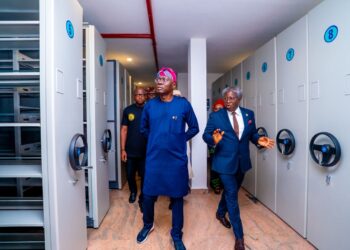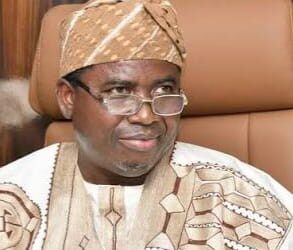



A business roundtable which took place,by the Nigerian Communications Commission which stood on the theme “Right of Way and Protection of Broadband Infrastructure ; The Road to Success in Broadband Investment and Connectivity.”

The Executive Vice Chairman (EVC ) began by posing a striking question: “How much is an hour of connectivity worth?” He enlisted vivid examples of how connectivity drives productivity and national security, from industrialists in Enugu closing overseas deals to entrepreneurs in Lagos managing e-commerce stores and security operatives depending on live intelligence feeds. Connectivity, he stressed, is the “quiet enabler” of modern life, and when it fails, opportunities vanish, productivity drops, and lives may even be at risk.
He noted that artificial intelligence (AI) have now become the new engines of growth. “Those who seize the moment prosper; hesitation carries a heavy cost,” he said, emphasising that connectivity now equates to economic inclusion, productivity, and national resilience.
The ICT and telecom sector, one of the largest contributors to Nigeria’s GDP, has the potential to drive exponential growth. Citing research, the EVC noted that a 10% increase in broadband penetration could translate to about 1.38% GDP growth in developing economies. “Imagine what a 20%, 30%, or 40% increase could achieve, billions in economic output, new jobs, services, and innovation hubs across our states,” he said.
He applauded President Bola Ahmed Tinubu and the Minister of Communications, Innovation and Digital Economy, Dr Bosun Tijani, for steering the implementation of the National Broadband Plan (2020–2025), which targets 70% broadband penetration by the end of 2025 and 90,000 kilometres of fibre optic backbone infrastructure across the country. He highlighted several strategic actions taken by the NCC, including the signing of the Critical National Information Infrastructure (CNII) Presidential Order by President Tinubu in June 2024.
To ensure full operationalisation, the NCC and the Office of the National Security Adviser (ONSA) has established a Telecommunications Industry Working Group to enforce site security standards and raise nationwide public awareness. The Commission also strengthened collaborations with state governments and the judiciary to ensure deterrence and prosecution of offenders, while ONSA dismantled major cartels behind telecom equipment theft.
Addressing one of the sector’s biggest barriers, the EVC lamented the high cost of Right of Way (RoW) fees despite the Nigerian Governors Forum’s resolution fixing the rate at ₦145 per linear metre. Through NCC’s advocacy, five additional states, Adamawa, Bauchi, Enugu, Benue, and Zamfara, have waived RoW fees entirely, bringing the total to eleven, while 17 others capped it at ₦145.
He further disclosed that in 2025, the NCC approved cost-reflective and competitive tariff rates to boost investor confidence, resulting in operators pledging over $1 billion in new investments for broadband expansion. The Commission also commissioned a wholesale fibre study to facilitate open access and unlock last-mile connectivity.

However, challenges exist,Between January and August 2025, Nigeria recorded 19,384 fibre cuts, 3,241 equipment theft cases, and over 19,000 incidents of site access denials, disruptions that caused prolonged outages, revenue losses, and higher security costs. Other challenges include fragmented RoW regimes, weak coordination with road authorities, energy volatility, multiple taxation, and cumbersome permitting processes.
Which is why the round table meeting was held,the discussion was about removing friction so investment flows faster and value reaches citizens sooner which prompts NCC to launch two strategic tools in making connectivity and productive possible.
The Nigerian Communications Commission ensures to protect and expand Nigeria’s connectivity. But this is not a task the commission can embark on alone, it is a shared mission.
The commission calls for alignment, investment and protection for the prosperity
of our people and the future of our nation.

L-R: Director, Critical National Assets and Infrastructure Protection, Office of the National Security Advisers (ONSA), Enebong Effiom; Executive Governor, Katsina State, Dikko Radda and Executive Vice Chairman/Chief Executive Officer, Nigerian Communications Commission (NCC), Dr. Aminu Maida, during a business roundtable on broadband investment and critical national infrastructure protection hosted by the Commission in Abuja on Wednesday (October 8, 2025).