




… Oba Adésínà Fákáyòdé Fálúadé to host grand finale in Ògùn State
Written By Rashidat O. Okunlade | Lagos
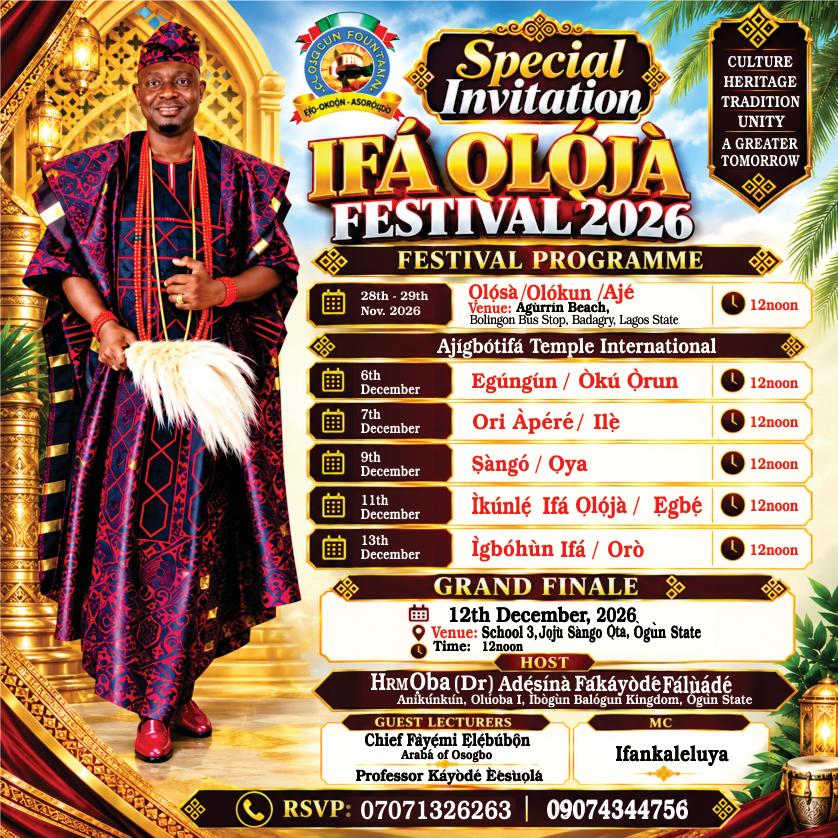
The ancient city of Badagry, Lagos State, and Ògùn State are set to play host to the Ifá Olójà Festival 2026, a landmark cultural celebration dedicated to the preservation and promotion of Yoruba heritage, tradition, and unity.
Organised under the theme “Culture, Heritage, Tradition, Unity – A Greater Tomorrow,” the festival promises a rich programme of traditional rites, performances, and intellectual engagements.
Ifa Oloja Festival 2026 Programme

The celebration will unfold in two phases, beginning with a two-day opening event in Lagos:
Phase One: Lagos
Date: November 28–29, 2026
Time: 12:00 noon daily
Event: Olósà / Olókun / Ajé
Venue: Agurin Beach, Bolington Bus Stop, Badagry, Lagos State
Phase Two: Ògùn State
The festival continues at the Ajigbótifá Temple International in Ògùn State with a series of daily traditional observances, all commencing at 12:00 noon:
December 6, 2026: Ẹgúngún / Òkú Ọ̀run
December 7, 2026: Orí Àpéré / Ilè
December 9, 2026: Sàngó / Ọya
December 11, 2026: Ìkúnlè Ifá Olójà / Egbé
December 13, 2026: Ìgbóhùn Ifá / Orò
Grand Finale of The Event
The festival will climax on Saturday, December 12, 2026, at School 3, Jọ̀ju Sàngó Ọta, Ògùn State, beginning at 12:00 noon.
Host and Guest Lecturers
The grand finale will be hosted by His Royal Majesty Oba (Dr.) Adésínà Fákáyòdé Fálúadé, Anikinnikùn OluObà 1, Ìbogun Balogun Kingdom, Ògùn State.
The event will feature distinguished guest lecturers:
Chief Fáyẹ́mí Elébùbọ̀n — Àràbà of Oṣogbo
Professor Káyọ̀dé Ẹ̀sọ̀ọlá
The Master of Ceremonies (MC) for the occasion is Ifankaleluya.
Ifá Olójà Festival 2026: A Grand Celebration Of Culture, Heritage, Tradition
Who Is Oba Adesina Fakayode Faluade?
The Monarch and Ifá Priest Hosting Ifá Olójà Festival 2026, a custodian of Yoruba heritage whose passion for tradition spans decades
When the grand finale of the Ifá Olójà Festival 2026 convenes on December 12 at School 3, Jọ̀ju Sàngó Ọta, Ògùn State, it will be hosted by a monarch whose life embodies the very traditions the festival celebrates: HRM Oba (Dr.) Adésínà Fákáyòdé Fálúadé, Anikinnikùn OluObà 1, Ìbogun Balogun Kingdom.
But who exactly is Oba Faluade, and why does his name carry such weight in Yoruba cultural circles?
A Dual Calling: Monarch and Ifá Priest
Oba Faluade occupies a rare position in Yoruba traditional institutions: he is both a crowned monarch and a practising Ifá priest. In a 2019 interview with Tribune, he explained that this duality is not a contradiction but a continuity of tradition exemplified by Orunmila himself.
“Being an oba does not prevent me from my role as a priest of Ifa. Besides, I am not the first Ifá Priest to be crowned an oba. It all started from ̀̀Orúnmìlà the author of Ifá. In Ìwòrì méjì, an Ifá chapter, when ̀̀Orúnmìlà was crowned as the oba of Adó-Ewí, ̀̀Orúnmìlà did not neglect the practice of Ifá due to his new role as a crowned oba.”
He acquired his Ifá knowledge as a family heritage, learning from his father and grandfather before seeking further instruction from three different masters, including Pa Alàní Fátunbí, the Alárámookì of Egbá land. He has described Ifá as a discipline that teaches humility, noting that “one cannot have a full knowledge of Ifá and be proud.”
Early Life and Education
Born and bred in Sango Ota, and Ogun State, Oba Faluade attended O.D.C Primary School, Sango Ota, and Ansar-ud-deen Grammar School before completing his secondary education at Nawar-Ud-Deen Grammar School, Sholu, Ifo. He studied Linguistics, African and Asian Studies at the University of Lagos (UNILAG), Masters in view.
His commitment to learning earned him recognition from the University of Lagos, where he is listed as a contributor to research on “Leadership, Religion and Divination,” with folktales cited as an important cultural heritage derived from the Ifá corpus.
A Foundation Built on Heritage
Oba Faluade is the Founder of the Ifa Olokun Foundation, an organisation established to promote African heritage and the divination system of Orunmila globally. He is also the chief priest of Ajigbotifa Temple International and the Ogbe Ola Philosophy Centre.
Through these platforms, he has positioned himself at the forefront of efforts to rehabilitate the image of traditional religion, dispel long-held misconceptions, and promote cultural pride. He has been a vocal critic of the conflation of authentic Ifá practice with ritual killings, stating unequivocally that any traditionalist using human parts for sacrifice is a “fraudster” and that no true Ifá priest would ever demand such offerings.
“God has blessed Africans, especially Nigerians, with many cultures that could boost the country’s economy through tourism,” he stated in a previous interview, expressing concern that the neglect of indigenous heritage has had “negative effects such as criminality and other social norms.”
Philanthropy and Community Development
Oba Faluade’s advocacy extends beyond spiritual pronouncements to tangible community development. His coronation anniversaries have become notable for their blend of cultural rites and philanthropy.
Past celebrations included:
Free eye screening and cataract surgeries for community members
Construction of modern market stalls
Provision of electricity transformers and street lights
Establishment of a community secondary school in Ibogun
Commissioning of state-of-the-art security posts
Prayers at Osa and Okun beaches in Badagry for the nation’s socio-economic growth
At his first-year coronation anniversary, the Baba Oba of Ibogun, Chief Ambaliu Yusuf, noted that “with modern stalls in our major markets, good toilets in our community school and also the commencement of the construction of another secondary school building project, our Oba’s reign has, no doubt, brought succour, hope and relief to the community.”
His leadership has earned him recognition beyond his kingdom. The Yoruba Council of Youths Worldwide installed him as its Royal Patron in recognition of his “unalloyed commitment and support towards the promotion of Yoruba Social-Cultural heritage.”
A Voice for Cultural Prowess and Tradition
Oba Faluade has become a leading advocate for deeper understanding of indigenous spirituality and its role in national development.
In 2026, he officially announced August 20 as the date for the annual cultural and spiritual observance, extending an invitation to “all sons and daughters of Yorubaland, home and abroad, to embrace their ancestral heritage.”
“We must not forget where we come from,” the monarch stressed, urging adherents and practitioners of the traditional faith to stand firm in their cultural identity.
Celebrating Others Who Preserve Heritage
Oba Faluade has also been consistent in celebrating fellow custodians of Yoruba tradition. He publicly eulogised the Araba of Osogbo, Chief Ifáyẹmi Ọ̀ṣúndàgbonù Elebuibon, describing him as “an unblemished cultural ambassador and custodian of Yoruba heritage.” He also praised the Aare Ona Kakanfo of Yorubaland, Otunba Gani Adams, as “a colossus in the fields of social engineering, promotion of Yoruba culture.”
The Ifá Olójà Festival Connection
The Ifá Olójà Festival 2026, which Oba Faluade will host for its grand finale, aligns closely with his lifelong mission. The festival’s theme “Culture, Heritage, Tradition, Unity – A Greater Tomorrow” mirrors the philosophy he has championed for decades: that preserving heritage and advancing society are not competing imperatives but mutually reinforcing pillars.
For Oba Faluade, the festival is more than a ceremonial occasion. It is a platform for the intergenerational transfer of knowledge, the celebration of communal identity, and the reaffirmation of Yoruba spiritual practice as a living, breathing tradition not a relic of the past.
Ifá Olójà Festival 2026: A Grand Celebration Of Culture, Heritage, Tradition
Why It Matters
Oba Faluade represents a model of traditional leadership that is increasingly rare: a monarch who is simultaneously a spiritual practitioner, an intellectual, a philanthropist, and a cultural advocate. His dual role as Oba and Ifá priest challenges the artificial separation between governance and spirituality that colonial modernity imposed on African societies.
His emphasis on tourism as an economic driver rooted in cultural heritage also offers a development paradigm that values what Nigeria already possesses rather than what it must import. In a country grappling with questions of identity and economic diversification, that perspective carries weight beyond the confines of Yoruba tradition.
When the Ifá Olójà Festival 2026 convenes in Ògùn State, it will be more than a cultural event. It will be a statement that the traditions of the ancestors remain vibrant, relevant, and capable of shaping a greater tomorrow.
Festivals like Ifá Olójà occupy a unique space in Nigeria’s cultural landscape. They are not merely performances for public consumption; they are living expressions of spiritual practice, communal memory, and intergenerational knowledge transfer.
Ifá, as a system of divination and philosophy, is central to Yoruba cosmology and has been recognised by UNESCO as part of the Intangible Cultural Heritage of Humanity. Its preservation is not merely a matter of cultural nostalgia but a contribution to global cultural diversity.
The Ifá Olójà Festival 2026, with its deliberate focus on heritage, tradition, and unity, reflects a growing movement among traditional institutions and cultural practitioners to reclaim, celebrate, and project indigenous knowledge systems. By convening in both Lagos and Ògùn State drawing participants from across the Yoruba world and beyond, the festival reinforces the interconnectedness of Yoruba communities.
The inclusion of guest lecturers alongside traditional rites signals an important synergy: faith and scholarship, ritual and intellect, tradition and contemporary discourse. This integration is essential if cultural heritage is to remain relevant to younger generations.
As Nigeria continues to navigate questions of identity, development, and national cohesion, platforms like the Ifá Olójà Festival remind us that culture is not an obstacle to progress, it is a foundation for it. A greater tomorrow is built on the heritage we preserve today.



